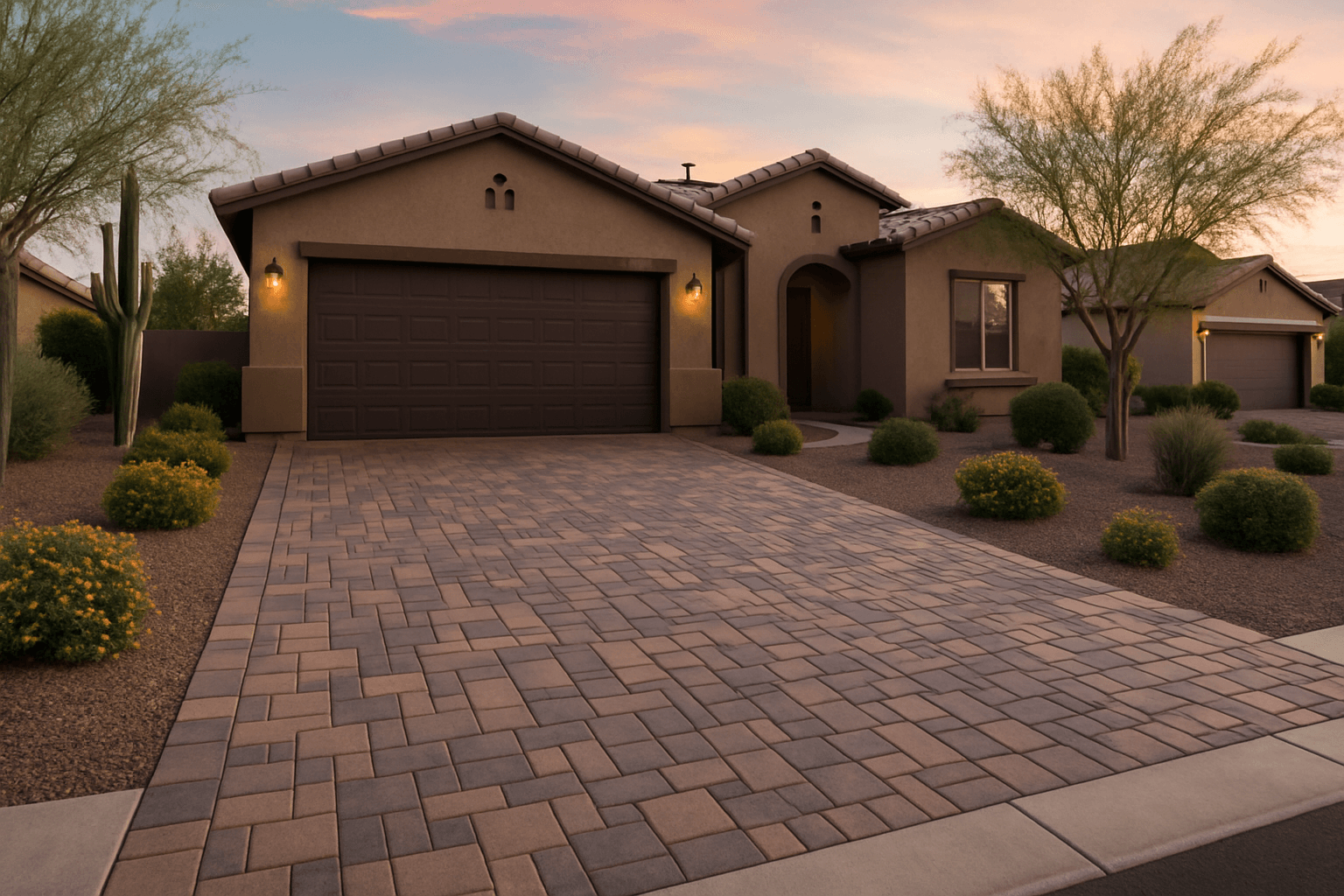
Let’s be honest, pulling up to your home after a long day in the Gilbert heat should feel good, not like you’re parking on a cracked, sun-bleached runway. Your Driveway is literally the first thing people see—it takes up a huge chunk of your front yard visual—yet it’s often the last thing homeowners think about upgrading until it’s falling apart. Upgrading to driveway pavers isn’t just about vanity; it’s a smart financial move that protects your property value without necessarily emptying your savings account.
Contents
- 1 Wait, Do Pavers Actually Increase Value?
- 2 The “Bang for Your Buck” King: Concrete Pavers
- 3 Why Design Patterns Matter (And Save Money)
- 4 The “Hidden” Benefit: Maintenance and Repairs
- 5 Permeable Pavers: Handling the Monsoons
- 6 Navigating the HOA Landscape
- 7 Installation: Where the Real Value Is
- 8 A Quick Note on Sealing
- 9 Comparing the Numbers
- 10 Ready to Transform Your Driveway?
Wait, Do Pavers Actually Increase Value?
You might be wondering if laying down individual stones is really worth the effort compared to pouring a fresh slab of concrete. Here’s the thing: in the real estate world, curb appeal is king. It’s that initial gut feeling a buyer gets when they pull up to the curb. A standard grey slab says “functional,” but a well-designed paver driveway says “custom” and “maintained.”
Real estate agents in Arizona will tell you that outdoor living spaces and exterior aesthetics are huge selling points. We live outside a lot here (well, when it’s not 115 degrees).
When you install interlocking pavers, you are adding a tangible asset. Unlike concrete, which is guaranteed to crack eventually due to the shifting soil and extreme temperature swings we get here in the desert, pavers are flexible. They move with the earth. If the ground shifts, the pavers adjust rather than snap. That longevity is a major value proposition for potential buyers who don’t want to inherit a maintenance headache.
The “Bang for Your Buck” King: Concrete Pavers
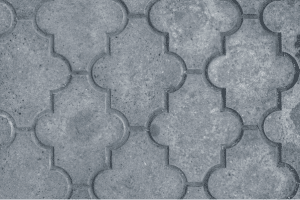
If we are talking about keeping costs down while getting that high-end look, concrete pavers are pretty much the undisputed champion. Don’t let the word “concrete” fool you; we aren’t talking about boring grey slabs. These are manufactured units that can mimic the look of natural stone, brick, or even cobblestone.
The reason they are so cost-effective comes down to manufacturing. Because they are mass-produced in molds, the cost per square foot is significantly lower than quarrying natural stone like travertine or granite.
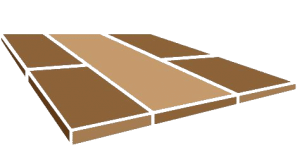
Plus, the variety is insane. You can get them in warm, desert tones—think terracotta, sand, and slate—that match the typical Gilbert aesthetic perfectly. You know what? Mixing a couple of different colors to create a border or a subtle pattern can make a standard driveway look like a custom estate entrance without actually adding much to the material cost. It’s a designer trick that adds value for pennies.
Why Design Patterns Matter (And Save Money)
This is where it gets interesting. The pattern you choose affects the structural integrity of the driveway and the installation cost.
If you choose a complex, swirling pattern with lots of intricate cuts, labor costs go up. However, going with a classic pattern can look amazing and keep labor time down.
Common Cost-Effective Patterns
| Pattern | Durability | Cost Factor | Visual Style |
|---|---|---|---|
| Running Bond | Medium | Low | Clean, linear, modern look. Very little waste. |
| Herringbone | High | Medium | Classic, highly interlocking. Great for heavy vehicles. |
| Basket Weave | Medium | Low-Medium | Old-world charm, vintage feel. Easy to lay. |
For driveways, I usually recommend a Herringbone pattern set at 45 degrees. It’s the strongest interlock. When you turn your car wheels, the tires exert force on the pavers. Herringbone distributes that load better than almost anything else, preventing the pavers from shifting over time. It looks expensive, but it’s actually quite standard to install.
The “Hidden” Benefit: Maintenance and Repairs
Let me explain a scenario that happens all the time. You have a giant concrete driveway. One day, the utility company needs to fix a pipe running underneath it. Or maybe a tree root pushes up a section. With poured concrete, you have to jackhammer the whole section out, leaving you with a weird “patch” that never matches the original color. It looks terrible.
With pavers, it’s a totally different story. We just zip out the pavers in the affected area, fix the pipe or the root, and put the same pavers back. Once we sweep in some new joint sand, you literally cannot tell anything happened.
This is a huge factor for long-term cost effectiveness. You aren’t paying for a new driveway every time a minor issue pops up. For a homeowner in Gilbert, where the soil can be tricky, this “zipper factor”—the ability to open and close the surface—is a financial lifesaver.
Permeable Pavers: Handling the Monsoons
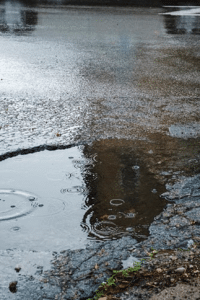
We all know how Gilbert gets during monsoon season. The sky opens up, and suddenly the streets are rivers. Standard concrete sheets water right off, often flooding flower beds or pooling near the garage foundation.
Permeable pavers are designed with slightly wider joints filled with a porous aggregate (basically small crushed stone). This allows rainwater to seep through the driveway and back into the ground naturally.
While the material cost might be slightly comparable to standard pavers, you save money by avoiding drainage issues. You might not need to install expensive French drains or trench drains if your driveway manages the water for you. Plus, keeping water away from your home’s foundation prevents costly structural damage later on. It’s proactive protection.
Living in Gilbert usually means dealing with an HOA. Honestly, they can be a pain about exterior changes. However, most HOAs actually prefer pavers over concrete because they look better and increase the neighborhood’s overall value.
That said, you have to be careful with colors and coverage. Most associations have a pre-approved list of colors—usually earth tones that blend with the desert landscape. Going with a cost-effective concrete paver in a standard “desert blend” is almost always a safe bet for fast approval.
If you try to get too fancy or use exotic materials, you might face delays or rejections. Sticking to the classics isn’t just cheaper; it’s administratively easier.
Installation: Where the Real Value Is
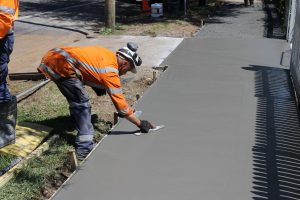
You might be tempted to try a DIY approach to save a few bucks. I’ve seen plenty of homeowners try this, and here is what usually happens: it looks great for about three weeks. Then, the first heavy car drives over it, or we get a heavy rain, and the pavers start to sink or wobble.
The most critical part of a paver driveway isn’t the stone itself; it’s what you don’t see. It’s the sub-base.
In Arizona, we typically need to excavate about 8 to 10 inches of native soil. Then we compact a road-base material—a mix of gravel and dirt—until it’s hard as a rock. Then comes the bedding sand. If you skip these steps or skimpy on the base material, your driveway will fail. Guaranteed.
Paying a professional to get the base right ensures that your investment lasts for 25 or 30 years, rather than needing a redo in two. That is the definition of cost-effective.
A Quick Note on Sealing
Should you seal your pavers? It’s an extra cost, yes. But if you want to protect the color from fading under the brutal Arizona sun, it’s worth considering.
Unsealed pavers can fade over a decade. A good sealer enhances the color (gives it that “wet look” if you want) and stabilizes the joint sand so weeds don’t pop up as easily. Think of it like waxing your car. You don’t have to do it, but the paint lasts a lot longer if you do.
Comparing the Numbers
Let’s break it down simply.
- Asphalt: Cheapest upfront, but melts in AZ heat and needs constant resealing. Looks… okay at best.
- Poured Concrete: Moderate cost. Will crack. Repairs are ugly.
- Stamped Concrete: More expensive than standard concrete. Slippery when wet. Still cracks, and harder to patch than standard concrete.
- Interlocking Pavers: Moderate to high upfront cost, but low long-term maintenance. High resale value. Doesn’t crack.
When you factor in the lifespan and the increase in home value, pavers often come out as the smartest financial choice over a 10-year period. You are putting money into the house that you will likely get back when you sell.
Ready to Transform Your Driveway?
Your driveway handles a lot—heavy SUVs, scorching heat, and the occasional oil leak. It deserves to be built tough, but that doesn’t mean it can’t look incredible. At Gilbert Paver Company, we specialize in helping homeowners find that sweet spot between budget-friendly materials and high-end design. We know the local soil, the HOA rules, and how to build a base that outlasts the mortgage.
Don’t settle for cracks and stains. Let’s look at your options and see how we can boost your curb appeal this week.
Contact Us today to get started:
Call us at 480-534-9680
Or Request a Free Quote on our website.