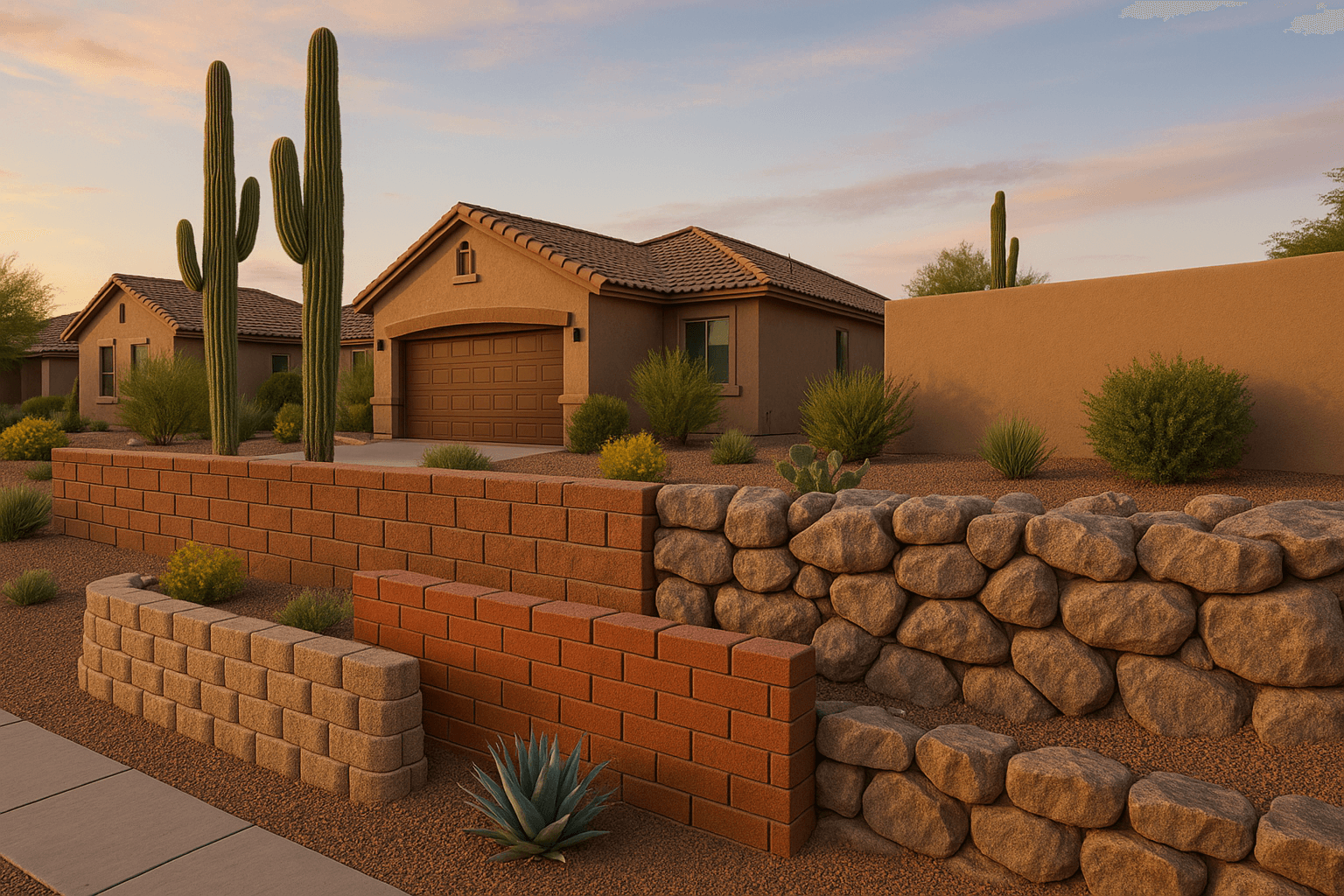
You look out at your backyard and visualize a tiered garden or maybe just a flat space where the kids can actually run around without tumbling down a slope, and you realize you need some structure. It’s not just about stacking a few rocks; it’s about holding back tons of earth while battling the relentless Gilbert sun. Before you commit to a project that digs into your savings, you probably want to know how long this thing is actually going to last.
Contents
- 1 Why Longevity Matters in the Desert
- 2 The Timber Dilemma: Wood Retaining Walls
- 3 Poured Concrete: The Industrial Heavyweight
- 4 Segmental Concrete Pavers: The Modern Standard
- 5 Natural Stone: The Luxury of Geology
- 6 Gabion Walls: The Trendy Contender
- 7 Let’s Compare the Lifespans
- 8 It’s Not Just the Material, It’s the Installation
- 9 The “Invisible” Damage of the Sun
- 10 Signs Your Current Wall is Failing
- 11 Why We Lean Towards Segmental Pavers
- 12 Maintenance Tips to Extend the Life
- 13 So, What’s the Move?
Why Longevity Matters in the Desert
Let’s be honest for a second. In Gilbert, AZ, we aren’t dealing with mild weather. We have soil that can be sandy or rich in clay, and we have a sun that bakes everything it touches. When you’re looking at Retaining Wall materials, you aren’t just picking a color you like. You are picking a fight with gravity and the elements.
If you choose the wrong material, you might be looking at a crumbling mess in five years. Choose the right one, and your grandkids will be playing on that same lawn. It really comes down to the cost per year of ownership. A cheaper wall that fails in a decade is way more expensive than a quality wall that lasts a lifetime.
So, let’s break this down. We’re going to look at the most common materials used here in the valley, from the budget-friendly options to the high-end stuff, and see how they stack up against the clock.
The Timber Dilemma: Wood Retaining Walls
I’ll start with wood because it’s usually the first thing people ask about when they want to save money. And I get it—timber walls have that rustic, natural look. They blend in well with a garden. Railroad ties used to be the gold standard for this.
But here is the thing about wood in Arizona: it is fighting a losing battle.
Even with pressure-treated lumber or those heavy creosote-soaked railroad ties, wood is organic. It wants to decompose. In wet climates, you worry about rot from moisture. In Gilbert? You worry about dry rot and termites. Termites love a good timber wall. It’s like an all-you-can-eat buffet that also serves as a house.
Expected Lifespan: 10 to 15 years.
The Verdict: It’s cheap upfront, but you will be replacing it. If you plan on moving in a few years, maybe it works for you. If this is your forever home, I’d suggest looking elsewhere.
Poured Concrete: The Industrial Heavyweight
You see these a lot in commercial spaces or modern homes. Poured concrete is incredibly strong. It’s a solid slab of heavy material holding back the dirt. It feels permanent.
However, concrete has an Achilles’ heel, especially in our climate. It’s rigid.
When the ground shifts—and the ground always shifts a little—poured concrete can’t flex. It cracks. And once a crack starts, water gets in. In the rare event we get a freeze (it happens!), that water expands and widens the crack. More commonly here, the intense heat causes thermal expansion. If the expansion joints aren’t placed perfectly, you get ugly, jagged cracks that are really hard to patch up so they look good again.
Expected Lifespan: 40 to 50 years (if built perfectly).
The Verdict: It lasts a long time, but when it starts to fail, it fails ugly. Plus, unless you face it with a veneer, it looks a bit plain.
Segmental Concrete Pavers: The Modern Standard
Okay, now we are getting into my wheelhouse. You’ve seen these everywhere in Gilbert. These are the interlocking blocks that look like stone but are actually engineered concrete.
There is a reason Gilbert hardscaping companies (like us) love these. It’s not just because they look clean. It’s because they are installed as a “flexible system.”
Let me explain what that means. Unlike poured concrete, these blocks are stacked without mortar. They are held together by their weight, a lip on the back of the block, and friction. When the ground swells or shrinks, the wall moves with it. It can flex millimeters here and there without cracking.
Plus, they come in a million colors and textures. You can get that tumbled, old-world look or a sharp, modern geometric vibe.
Expected Lifespan: 50 to 100 years.
The Verdict: This is arguably the best bang for your buck. They are incredibly durable, they handle the Arizona heat without complaining, and if one block gets damaged? You just swap out that one block. You don’t have to tear down the whole wall.
Natural Stone: The Luxury of Geology
There is something undeniable about real stone. Whether it’s stack stone or massive boulders, natural stone retaining walls are beautiful. They fit the desert landscape because, well, they are the landscape.
Boulders are popular here for that xeriscape look. You basically pile massive rocks on top of each other. Gravity does the work.
Since rocks have already survived millions of years of erosion, rain, and heat before they ever got to your backyard, they aren’t going to care about a few decades of service in your garden. The rock itself will last forever.
The weak point? The mortar. If you are doing a dry stack (no mortar), it lasts as long as the rocks stay balanced. If you use mortar, that mortar will eventually crack and need repointing.
Expected Lifespan: Indefinite for the stone; 20-30 years for the mortar joints.
The Verdict: If you have the budget, it’s gorgeous. But keep in mind that mortar maintenance is a real thing.
Gabion Walls: The Trendy Contender
You might have seen these popping up around town lately. It’s basically a wire cage filled with rocks. It sounds industrial, but it actually looks really cool in a modern, desert setting.
The huge advantage here is drainage. I can’t stress this enough—drainage is the number one killer of retaining walls. Water builds up behind a wall (we call this hydrostatic pressure) and pushes it over. With a Gabion wall, the water just flows right through the rocks. No pressure build-up.
The lifespan limiter here isn’t the rock; it’s the wire cage. Eventually, even galvanized steel will rust, though it takes a very long time in our dry air.
Expected Lifespan: 50 to 75 years.
The Verdict: excellent for drainage and modern aesthetics. Very low maintenance.
Let’s Compare the Lifespans
It helps to see it all in one place, right? Here is a quick cheat sheet for you.
| Material | Estimated Lifespan | Main Threat in AZ |
|---|---|---|
| Wood / Timber | 10 – 15 Years | Termites, Dry Rot, UV damage |
| Poured Concrete | 40 – 50 Years | Cracking from thermal expansion |
| Segmental Pavers | 50 – 100 Years | Poor installation (base failure) |
| Natural Stone | 50+ Years (Indefinite) | Mortar crumbling |
| Gabion | 50 – 75 Years | Wire cage corrosion |
It’s Not Just the Material, It’s the Installation
Here is the kicker, though. You could buy the most expensive, Italian-imported stone in the world, but if the guy installing it doesn’t know what he is doing, it’s going to fall over in three years.
A retaining wall is an engineering feat. It’s resisting thousands of pounds of force. The lifespan of your wall depends heavily on what you can’t see.
The Foundation
The wall has to sit on something solid. We usually dig a trench and fill it with a compacted aggregate base. If you just slap blocks on the dirt, the wall will settle, tilt, and eventually topple. In Gilbert, where we have that mix of sand and clay, getting the compaction right is everything.
Drainage (Again, because it’s important)
I mentioned hydrostatic pressure earlier. If you don’t give the water a place to go, it will make a place. A good wall needs:
- Drainage gravel directly behind the blocks.
- Filter fabric to keep dirt from clogging the gravel.
- Often, a perforated drain pipe at the bottom to carry water away.
If your contractor skips the drainage to save a few bucks, they are shaving decades off the life of your wall.
The “Invisible” Damage of the Sun
We talk a lot about water, but living in Arizona, we have to talk about UV rays. The sun here is brutal.
For wood, UV rays break down the lignin that holds the wood fibers together. That’s why old wood turns gray and splintery.
For concrete pavers, cheap products can fade. However, high-quality pavers are made with iron oxide pigments that are integrated all the way through the block, not just painted on top. This means they hold their color much longer, even under our blazing sun.
When we select materials for our clients, we always look for UV-resistant products. It’s a small detail that makes a huge difference in how your yard looks ten years from now.
Signs Your Current Wall is Failing
Maybe you are reading this because you already have a wall, and it’s looking a little… tired. How do you know if it’s time to replace it?
- Bulging: If the middle of the wall looks like it’s pushing out, that’s a drainage issue. It’s going to burst eventually.
- Leaning: If the whole thing is tipping forward, the foundation has failed.
- Crumbled Mortar: For stone walls, if you can pull chunks of mortar out with your fingers, the structural integrity is gone.
- Rotting Timber: If you poke a wood wall with a screwdriver and it sinks in, it’s toast.
Don’t wait until it collapses. A collapsed wall is way more expensive to fix because you have to excavate the collapsed dirt and the old materials before you can even start building the new one.
Why We Lean Towards Segmental Pavers
Look, we install different types of hardscaping, but if you ask me for my honest recommendation for a Gilbert homeowner, I’m almost always going to point you toward segmental concrete retaining walls.
Why? Because they offer the best balance.
They last almost as long as stone but cost less. They look better than poured concrete. They don’t rot like wood. And because they are a dry-stack system (no mortar), they are flexible enough to handle our soil conditions.
Plus, the design options are endless. You can match them to your patio pavers, your pool coping, or the stucco on your house. It creates a cohesive look that really boosts your property value.
Maintenance Tips to Extend the Life
Even the best wall needs a little love. You don’t have to baby it, but a little attention goes a long way.
- Keep Weeds Out: Weeds are strong. Their roots can push blocks apart or crack mortar. Pull them early.
- Check the Drainage: Make sure the drain pipes aren’t clogged with debris. If water is pouring over the wall instead of through the pipes during a monsoon, you have a problem.
- Seal It: If you have concrete pavers or natural stone, applying a sealer every few years can protect the color and prevent staining. It’s like sunscreen for your hardscape.
So, What’s the Move?
Deciding on a retaining wall is a big decision. It changes the shape of your yard and protects your property. You want to do it once, and you want to do it right.
While wood might tempt your wallet today, consider the headache of replacing it in a decade. Investing in concrete pavers or natural stone is usually the smarter play for Arizona homeowners who want peace of mind.
You don’t have to figure this out alone, though. We’ve seen every type of soil and slope Gilbert has to offer. We can look at your yard, listen to what you want to achieve, and give you a straight answer on what material will work best for your budget and your timeline.
Let’s get your backyard looking incredible and staying that way.
Contact Gilbert Paver Company today.
Call us at: 480-534-9680
Or click here to Request a Free Quote