It used to be that if you wanted to redo your backyard, you’d get a hand-drawn sketch that looked a bit like a treasure map, and you just had to trust that the contractor saw the same vision you did. Honestly, it was a bit of a gamble, wasn’t it? But today, the gap between what you imagine and what actually gets built in your Gilbert landscape design is closing fast, thanks to some pretty incredible technology.
Seeing Is Believing: The Magic of 3D Design
Here’s the thing about blueprints: most people can’t read them. I don’t mean that as an insult; it’s just that translating a flat, black-and-white drawing into a mental image of a lush, three-dimensional backyard is a skill that takes years to develop. For the longest time, homeowners just had to nod along while pointing at a circle on a paper labeled “Fire Pit,” hoping it wouldn’t end up looking like a pile of rocks.
That’s where 3D landscape rendering has completely flipped the script.
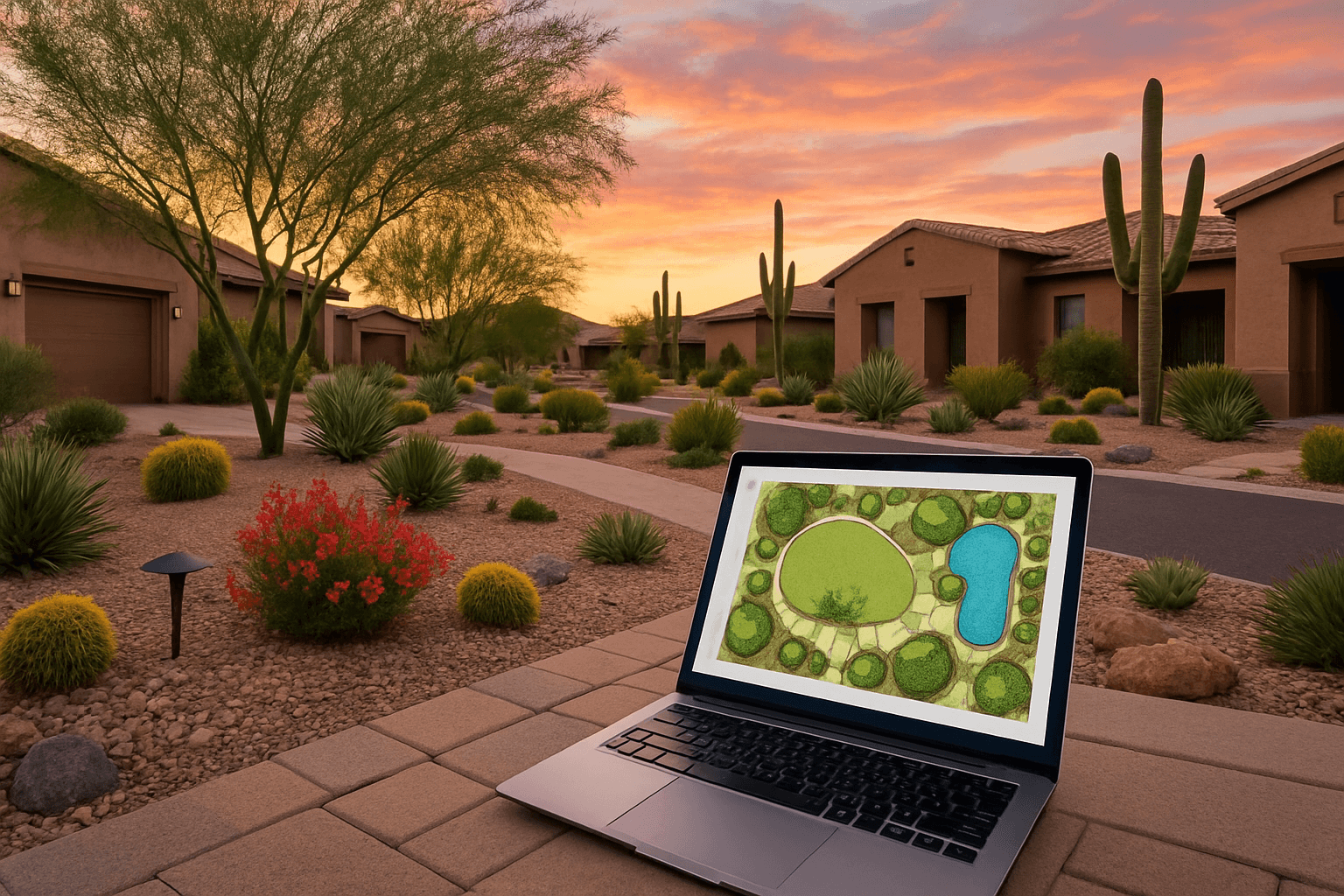
Nowadays, before a single shovel hits the dirt, we can build your entire outdoor living space digitally. We aren’t just talking about a rough cartoon, either. We’re talking about photorealistic walkthroughs where you can see how the shadows fall on your travertine pavers at 4:00 PM in July versus 4:00 PM in December. That matters here in Gilbert, right? Because nobody wants to build a beautiful seating area that turns into a frying pan during happy hour.
Using software like SketchUp or Lumion, we can simulate textures. You can see the difference between a tumbled paver look and a modern, smooth finish. You can see how the Artificial Turf contrasts with the decorative rock. It takes the “I hope this looks good” anxiety out of the equation.
Smart Water: Keeping Green in the Desert
Let’s talk about water for a second. Living in the East Valley, we all have that low-level guilt—or just fear of the water bill—when we think about keeping plants alive. The old way of doing things was setting a plastic timer in the garage and hoping you remembered to turn it off when we actually got one of those rare monsoon downpours.
Technology has gotten surprisingly smart about hydration. We are seeing a huge shift toward smart irrigation controllers—think of them like a Nest thermostat, but for your sprinklers.
Brands like Hunter or Rachio make controllers that connect to local weather stations via Wi-Fi. If rain is in the forecast for Gilbert, the system automatically skips a watering cycle. If it’s exceptionally hot and dry (which, let’s be real, is most of the time), it can adjust to give your trees a little extra sip.
This isn’t just about saving money, though that’s a nice bonus. It’s about plant health. Over-watering is actually the number one killer of desert plants. They hate having “wet feet.” These smart systems use soil moisture sensors buried right at the root level to tell the system exactly when the plant is thirsty. It’s precision agriculture, right in your backyard.
The Engineering Behind the Pavers
You might look at a Driveway or a patio and think, “It’s just bricks on sand.” Well, yes and no. The materials might be traditional, but the way we install them has gone high-tech.
Back in the day, leveling a site was done with string lines and bubble levels. It worked, mostly. But strings sag, and human eyes can be tricked. Today, we use laser grading technology to ensure the ground is perfectly prepped.
Why does this matter to you? Drainage.
If the slope is off by even a fraction of an inch, you end up with puddles right where you want to put your outdoor dining table. Or worse, water draining toward your foundation instead of away from it. Lasers don’t guess. They give us a precise benchmark to ensure that when we lay those interlocking pavers, they are sitting on a base that is engineered to handle the weight of your truck or the foot traffic of your next barbecue without shifting or sinking.
And while we are on the topic of pavers, the manufacturing tech has changed, too. We now have permeable pavers that actually allow water to pass through the joints and back into the ground, reducing runoff. It’s a great way to handle storm water without needing ugly drains everywhere.
Lighting the Night (Without the Hassle)
I remember when “outdoor lighting” meant a giant floodlight attached to the back of the house that blinded everyone, or those cheap solar stakes that give off about as much light as a dying firefly.
We’ve moved past that. Low-voltage LED lighting systems have revolutionized how we enjoy our yards after the sun goes down. And since it cools down nicely at night here in Arizona, that’s prime patio time.
But the real tech kicker here is control. With modern transformers (like those from FX Luminaire), you can zone your lighting. Want the lights on the path to be bright for safety, but the lights around the fire pit to be dim for ambiance? You can do that from your phone. You can even change the colors.
Imagine it’s Halloween—boom, your landscape lights are orange and purple. Cardinals game? Turn them red. It sounds a bit gimmicky until you actually try it, and then you realize how much fun it is to set the mood instantly. It’s about extending the livability of your home outside the four walls.
Comparison: Old School vs. New Tech
Sometimes it helps to see it side-by-side to really get why this matters.
| Feature | The Old Way | The High-Tech Way |
|---|---|---|
| Design Process | 2D Blueprints that require imagination | 3D Renderings and virtual walkthroughs |
| Grading & Leveling | String lines and bubble levels | Laser transits for perfect drainage slopes |
| Irrigation | Manual timers (set it and forget it… until plants die) | Wi-Fi Smart Controllers that react to weather |
| Lighting | Halogen bulbs (hot, energy hogs) | LED systems with color/dimming app control |
| Project Management | Phone tag and missed voicemails | Client portals with timeline updates |
The Robot Lawnmowers Are Actually Here
Okay, I had to mention this because it’s just cool. You know how robotic vacuums sort of blindly bump around your living room until the floor is clean? Well, robotic lawnmowers have been around for a while, but they used to be a pain because you had to bury a wire around the perimeter of your Grass so they wouldn’t run away down the street.
The new generation of automowers uses GPS and RTK (Real-Time Kinematic) positioning. Basically, they use satellites to know exactly where they are within a couple of centimeters. No wires needed.
If you have a patch of sod—maybe for the dog or the kids—and you hate mowing it in 110-degree heat, these little guys are a game changer. They are quiet, they mulch the clippings back into the grass (which is free fertilizer), and you never have to sweat. It’s not for everyone, especially if you have a tiny patch of synthetic turf, but for those sticking with real grass, it’s a lifesaver.
It’s Not Just About Gadgets, It’s About Communication
Here is a piece of technology people forget about in construction: communication tools.
Renovating your home, even just the outside, is stressful. There is noise, dust, and people walking through your gate. In the past, you’d have to chase your contractor to find out when the pavers were arriving.
Now, we use project management software that keeps everyone in the loop. It sounds boring compared to lasers and robots, I know. But knowing exactly when the demo crew is showing up or receiving a photo update while you’re at work makes the whole process feel less like a chaotic mess and more like a well-oiled machine. It keeps us accountable and keeps you informed.
The Human Touch Still Matters
After all this talk about software, lasers, and smart systems, I have to be clear about one thing. Technology is just a tool. It’s a hammer, essentially—a really fancy, expensive, digital hammer.
You can have the best 3D landscape design software in the world, but if the person using it doesn’t understand composition, flow, or which plants survive an Arizona summer, you’re just going to get a high-definition picture of a bad design.
You can have laser levels, but if the crew laying the paver patio doesn’t have the craftsmanship to cut the borders tightly or compact the sub-base correctly, the patio will still fail.
Technology enhances the skills of a craftsman; it doesn’t replace them. In Gilbert, where the soil is full of clay and the sun is unforgiving, you need that local expertise combined with the modern tech. That’s the sweet spot.
Let’s Build Something Amazing Together
You know what? It’s easy to get overwhelmed by the options. You might be sitting there thinking, “I just want a nice place to drink my coffee in the morning; do I really need lasers?”
Maybe not all of them. But you do deserve a backyard that is built to last, designed so you can visualize it before spending a dime, and installed with the precision that modern tools allow. Whether you are looking for a simple paver walkway or a full outdoor kitchen and living area, we combine old-school work ethic with new-school technology to get it right.
Ready to see what your yard could look like?
Call us today at 480-534-9680
Let’s make your neighbors jealous.