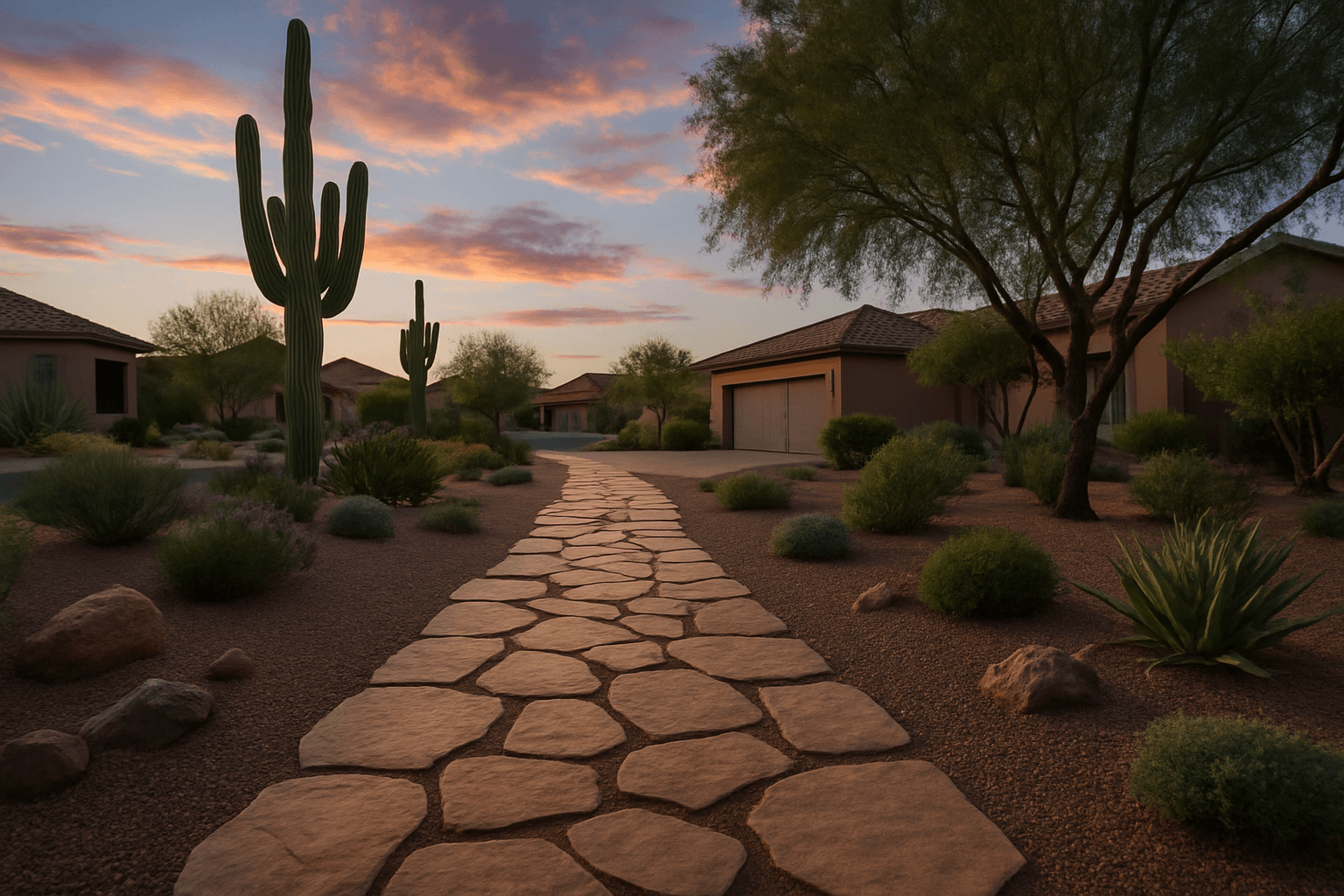
There is something incredibly satisfying about standing at the edge of your yard, looking at a dusty, worn-out patch of Grass (or let’s be honest, just dirt), and imagining a beautiful, winding stone path. It changes the whole vibe of the property, doesn’t it? Laying a stone walkway is one of those projects that sits right in the sweet spot of DIY home improvement: it’s physically demanding enough to make you feel like you conquered something, but technically accessible enough that you don’t need a degree in civil engineering to pull it off.
First Off: The Vision and The Reality
Before we run out and start buying pallets of stone, we need to have a little chat about what you’re actually getting into. You see, a lot of homeowners in Gilbert, AZ see those time-lapse videos online where a guy builds a patio in twenty seconds. It looks easy.
Here’s the thing: it is simple, but simple doesn’t mean easy.
You are going to be moving thousands of pounds of material. Your back might complain about it the next morning. But if you are willing to put in the sweat equity, you can save a significant chunk of change and end up with a hardscape feature that lasts for decades. Plus, there is no feeling quite like walking on a path you laid with your own two hands.
So, grab a cold drink, maybe sit down, and let’s walk through this process step-by-step.
Step 1: Planning Your Path (Don’t Skip This)
I know the temptation is to just grab a shovel and start hacking away at the ground. Please don’t do that. You need a plan.
The best tool for designing a stone walkway isn’t some fancy computer software; it’s a couple of old garden hoses. Drag them out into the yard and lay them out to define the borders of your walkway. This lets you play with the shape in real-time. Do you want a straight, formal path that screams “English Garden”? Or are you looking for a meandering, organic curve that feels more natural in our desert landscape?
Once you have the hoses where you want them, walk the path. Seriously, pace it out. Does it feel too narrow? A comfortable walkway should be at least 36 inches wide—enough for two people to squeeze by each other, or for you to carry grocery bags without stepping into the flower beds.
Pro Tip: If you live in a newer build in Gilbert, keep an eye on your drainage. When the monsoons hit, where does the water go? Make sure your new path doesn’t turn into a dam that backs water up against your house foundation.
Step 2: Gathering the Gear
You can’t build a house without a hammer, and you can’t lay a walkway without the right gear. Here is a breakdown of what you will likely need. It’s better to have this stuff on hand than to be making your fourth trip to the hardware store covered in dust.
| Category | Item | Why You Need It |
|---|---|---|
| Excavation | Flat shovel & Spade | For the heavy lifting. |
| Prep | Wheelbarrow | Moving soil out, moving stone in. |
| Base | Plate Compactor | You can rent this. Hand tampers are okay for tiny spots, but trust me, rent the machine. |
| Leveling | 2×4 Board (Screed) | To smooth out your sand layer. |
| Tools | Rubber Mallet | For tapping stones into place without cracking them. |
| Safety | Gloves & Knee Pads | Your future self will thank you. |
Step 3: The Excavation (AKA The Hard Part)
Alright, this is where the rubber meets the road. Or rather, where the shovel meets the Arizona caliche.
If you have lived in the Valley for more than a summer, you know our soil isn’t exactly fluffy potting mix. It can be hard as rock. You need to dig out the area you marked with paint (spray paint along those garden hoses before you move them).
You generally need to dig down about 6 to 8 inches. Why so deep? Because if you just throw stones on top of the dirt, they will shift, sink, and heave the first time it rains or the ground settles. You need room for the paver base and the sand bed.
- Call Before You Dig: I cannot stress this enough. Call 811. It’s free. They will come out and mark your utility lines. Hitting a gas line or a fiber optic cable will ruin your weekend faster than anything else.
As you dig, try to keep the bottom of your trench relatively flat. It doesn’t have to be perfect, but you don’t want massive craters. And hey, take breaks. Hydrate. It gets hot out there.
Step 4: Building the Foundation
Here is a little secret from the pros: The most important part of a stone walkway isn’t the stone. It’s the stuff underneath it that nobody sees.
You need to install a compactable gravel base. This is usually called “ABC” (Aggregate Base Course) or just “road base.” It’s a mix of crushed stone and rock dust that packs down incredibly hard.
- Pour the Gravel: Add about 4 inches of this base material into your trench.
- Spread it Out: Use a sturdy rake to get it relatively even.
- Wet it Down: Spray it lightly with a hose. Water helps the particles slide together and lock up.
- Compact It: Fire up that plate compactor you rented. Run it over the gravel multiple times until the surface feels hard, almost like concrete.
If you skip this or try to cheat by only using an inch of gravel, your walkway will be wavy within a year. Honestly, do it right the first time so you don’t have to do it again.
Step 5: The Sand Bedding
Once your gravel base is rock-hard, you need a soft bed for the stones to nestle into. This is where bedding sand (usually concrete sand) comes in.
You aren’t trying to compact this layer yet. You just want a smooth, even layer about 1 inch thick. A great trick here is to lay two 1-inch PVC pipes parallel to each other on top of the hard gravel. Pour the sand between them, and then drag a straight 2×4 board (your screed) across the pipes. This levels the sand perfectly.
Remove the pipes and fill in the little grooves they left behind. Now, try not to walk on this sand! It’s like the surface of the moon—pristine. If you step on it, you create a divot that will mess up your stone laying.
Step 6: Laying the Stones
Finally! The fun part. This is where your project starts to actually look like a walkway.
Depending on the material you chose—maybe a natural flagstone or a manufactured concrete paver—your technique might vary slightly. But the principles remain the same.
Start from a corner or a straight edge. Place the stone directly down onto the sand. Don’t drag it across the sand, or you’ll ruin that perfect level you just made. Just drop it straight down.
The Puzzle:
If you are using irregular flagstone, this is like playing a giant, heavy game of Tetris. You want the gaps between the stones to be somewhat consistent, usually about 1 to 2 inches wide. If a stone is rocking or wobbling, lift it up, add a little sand underneath the low spot, and set it back down.
Use your rubber mallet to tap the stones down firmly so they settle into the bedding sand. You want the tops of the stones to be even with each other so nobody trips.
Step 7: Locking It All In
You’ve got the stones down. It looks great. But if you walk on it now, the stones might shift sideways. You need to lock them in place.
First, you need edge restraints. These are usually plastic strips that you spike into the ground along the edges of your walkway (hidden under the soil or mulch). They keep the stones from migrating into your lawn over time.
Next, you need to fill the gaps.
- The Old School Way: Stone dust or regular sand. It works, but weeds love it and rain washes it out.
- The Pro Way: Polymeric sand. This stuff is magical. It looks like sand, but it has binding agents in it.
Sweep the polymeric sand into the joints between your stones. Use a broom to get it into every crevice. Then—and this is crucial—use a leaf blower on the lowest setting to gently blow the fine dust off the surface of the stones. If you leave that dust on the stones and then get them wet, you will stain your beautiful new walkway.
Once the surface is clean, water the path with a gentle mist. The water activates the polymers in the sand, turning the joints into a firm, rubbery grout that resists weeds and ants.
Common Mistakes (Learn from Others’ Failures)
I’ve seen a lot of DIY walkways in Gilbert, and the ones that fail usually fail for the same reasons. Let’s make sure you aren’t one of them.
- The “Slope” Issue: You want your walkway to be mostly level, but it needs a tiny bit of slope (about a quarter inch per foot) away from your house. If you make it perfectly level, water might pool on it.
- Using the Wrong Sand: Don’t use play sand (the stuff for sandboxes). It’s too round and acts like ball bearings. The stones will never settle. You need sharp, jagged sand that locks together.
- Forgetting the Edging: I know, by the time you get to the edging, you are tired. You just want to be done. But without that edge restraint, the outer stones will start to drift away within months.
Maintenance: Keeping It Fresh
The beauty of a stone walkway is that it is low maintenance, not no maintenance.
Every once in a while, you might get a stubborn weed popping through. Pull it early. Depending on the exposure to the Arizona sun, you might want to seal the stones every couple of years. Sealing brings out the color (especially in flagstone) and protects it from stains—like when you inevitably drop a greasy burger on it during a backyard BBQ.
Also, if you used polymeric sand, keep an eye on the joints. After a few heavy monsoon seasons, you might need to top it off. It’s a quick Saturday morning job, nothing too strenuous.
When to Call in the Cavalry
Look, I am all for the DIY spirit. It’s empowering. But let’s be real for a second—laying a walkway is back-breaking work. You are moving tons of earth and stone. It requires specialized tools and a lot of patience.
Sometimes, you get halfway through the excavation, hit a layer of concrete-hard caliche, and realize you have made a terrible mistake. Or maybe you just want the beautiful result without the week of sore muscles and trips to the chiropractor.
That is perfectly okay. Actually, it’s pretty smart.
If you are looking at your yard and thinking, “I want this done right, and I want it done before the next holiday party,” we should talk. At Gilbert Paver Company, we do this every single day. We know the soil, we know the climate, and we know how to build walkways that survive the desert heat.
Why not save your back and let us handle the heavy lifting?
Contact Us today to get started on your dream yard:
→ Call us at 480-534-9680
→ or Request a Free Quote