You look out your back window and see potential, but maybe right now it’s just a patch of dirt, some patchy Grass, or a concrete slab that’s seen better days. It’s frustrating because you know that in Gilbert, our outdoor space is basically an extension of our living room for half the year. Transforming that space starts with understanding the “bones” of your landscape, and that’s exactly what we’re going to talk about.
So, What Exactly is Hardscaping?
Let’s keep this simple. If you look at a garden, the plants, the grass, the flowers—anything that’s living and breathing—that’s your softscape. Everything else? That’s hardscaping. We are talking about the solid, non-living elements that give your yard structure, functionality, and, honestly, a lot of its personality.
You know what? It’s kind of like building a house. The softscaping is the paint and the furniture, but the hardscaping is the foundation, the walls, and the floors. Without good bones, the decorations just don’t hold up. In our neck of the woods, this usually means paver patios, walkways, retaining walls, fire pits, and Pool Decks.
It’s easy to get caught up in picking out palm trees or deciding between Bermuda or rye grass, but the hardscape is where you actually live. It’s where you put the grill, where the kids draw with chalk, and where you sit with a cold drink after a long week.
Why Gilbert Homeowners Are Ditching the Lawn
Here’s the thing about living in the desert: maintaining a lush green lawn is a battle against nature. It requires a ton of water, constant mowing, and reseeding. That’s why so many folks in Gilbert are leaning heavily into hardscape designs.
It’s not just about aesthetics; it’s about practicality. When you replace a thirsty lawn with a beautiful travertine patio or a paver courtyard, you aren’t just saving on your water bill (though that’s a nice perk). You’re creating a low-maintenance zone that stays usable year-round. No mud tracking into the house during our monsoon season, and no brown patches to stress over in June.
Plus, there is the Return on Investment (ROI). A well-designed hardscape increases your home’s livable square footage. When you go to sell, buyers see that outdoor kitchen or that pristine paver Driveway and see value. It’s an investment that pays you back in enjoyment now and dollars later.
Choosing Your Materials: It’s Not Just About Color
This is where people usually get stuck. You walk into a showroom or look at a catalog, and there are a million options. But in Arizona, we have to think about something the rest of the country doesn’t: Heat.
If you pick the wrong material for your pool deck, you’re going to burn your feet. It’s that simple.
Travertine Pavers
This is the gold standard for Gilbert landscapes. Travertine is a natural stone that looks incredible—it has that classic, high-end feel—but its superpower is that it stays cooler to the touch than concrete or brick. You can walk on it barefoot in July without hopping around like you’re on hot coals. It’s durable, slip-resistant, and handles our freeze-thaw cycles (yes, we do get freezing temps occasionally) without cracking.
Concrete Pavers
These are the workhorses of the industry. Interlocking concrete pavers come in just about every shape, size, and color you can imagine. They are incredibly strong—strong enough for driveways—and because they are individual units, they won’t crack like a solid concrete slab. If the ground shifts (which happens with our clay soil), the pavers move with it.
Porcelain Pavers
This is a newer trend gaining traction. Porcelain is extremely hard, scratch-resistant, and doesn’t fade in the sun. It gives a very modern, sleek look. However, it can be a bit pricier to install because it requires specialized cutting.
Here is a quick breakdown to help you visualize the differences:
| Feature | Travertine Pavers | Concrete Pavers | Standard Concrete Slab |
|---|---|---|---|
| Heat Retention | Low (Stays Cool) | Medium | High (Gets Hot) |
| Durability | High | Very High | Medium (Prone to Cracking) |
| Maintenance | Low (Seal every 3-5 yrs) | Low (Seal every 2-3 yrs) | Medium (Stains easily) |
| Cost | Medium-High | Low-Medium | Low |
| Aesthetic | Natural, Elegant | Versatile, Uniform | Plain, Functional |
The “must-haves” for a Functional Yard
Okay, so you have picked your material. Now, what are you actually building? It’s rarely just a big square patio anymore.
Walkways and Paths
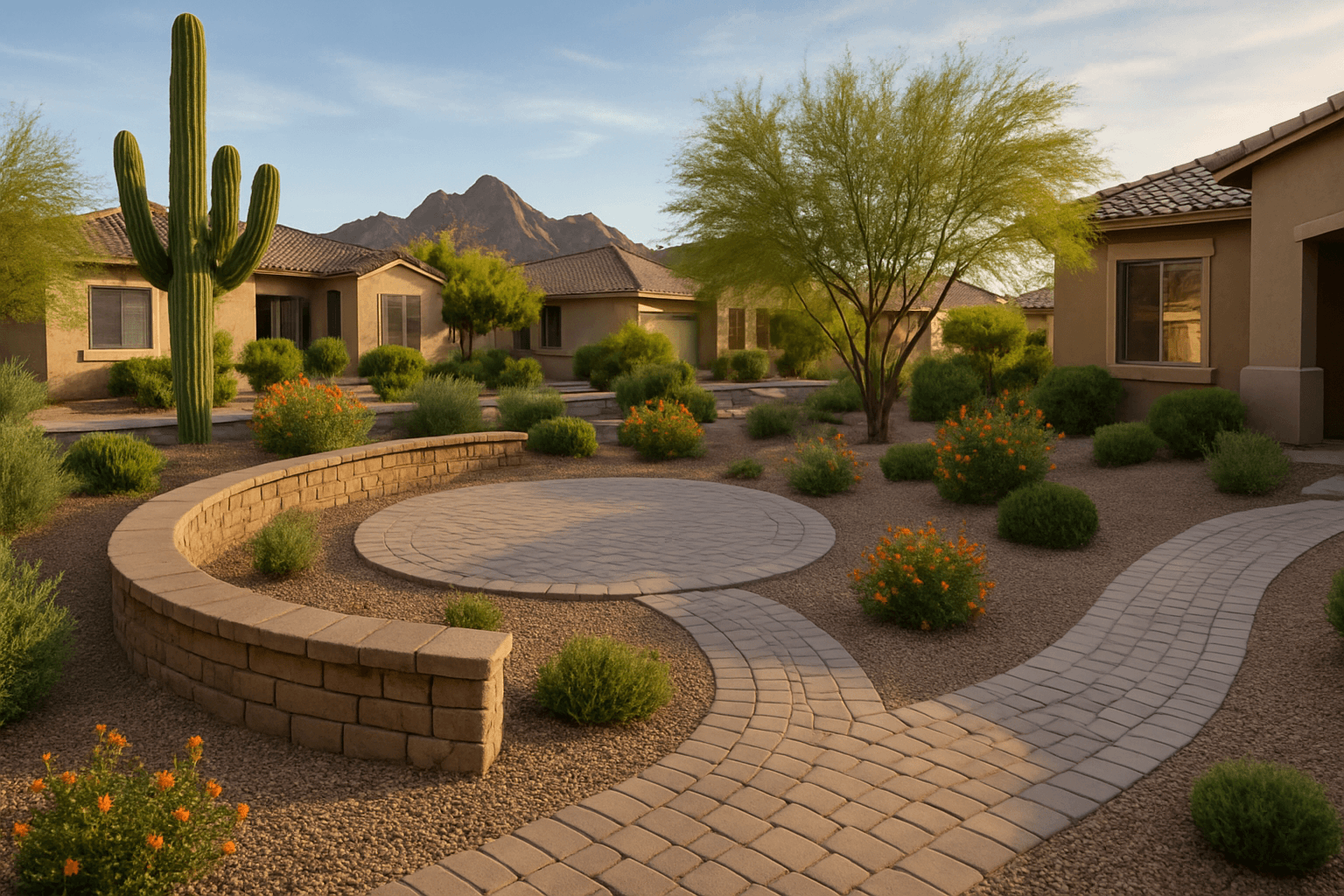
Don’t underestimate the power of a path. A paver walkway connecting your side gate to the back patio, or the patio to the pool, creates flow. It guides people where to go and keeps them off your landscape rock or turf. Curved paths tend to look more organic and natural, while straight paths feel formal and modern.
Retaining Walls and Seat Walls
Our yards in Gilbert are often relatively flat, but adding a Retaining Wall can create dimension. Even better? Build a seat wall around your Fire Pit or patio edge. It defines the space and provides permanent seating for parties so you don’t have to drag out twenty folding chairs.
Fire Features
Let’s be honest, winter evenings in Arizona are why we live here. A fire pit or an outdoor fireplace extends the usability of your yard by months. Whether it’s gas-burning (for that instant on/off convenience) or wood-burning (for the nostalgia and smell), it becomes the focal point of the backyard.
It’s What’s Underneath That Counts
You might look at a YouTube video and think, “I could probably lay these pavers myself.” And you know what? You might get them down. But the difference between a DIY job and a professional installation usually shows up about six months later.
The most critical part of hardscaping isn’t the stone you see; it’s the base you don’t see.
Here is how the pros at Gilbert Paver Company approach it. We start by excavating the native soil. Arizona soil can be tricky—it’s often expansive clay that swells when wet and shrinks when dry. If you just throw pavers on top of dirt, they will shift. Your patio will look like a roller coaster within a year.
We install a heavy-duty aggregate base—usually crushed stone—and compact it until it’s rock hard. This creates a stable foundation that drains well. Then comes the bedding sand, and finally, the pavers. After the pavers are laid, we use polymeric sand in the joints. This isn’t regular beach sand; it has a binding agent that hardens when watered, locking the pavers in place and preventing weeds and ants from moving in.
It’s technical work, and getting the slope right so water drains away from your house foundation is absolutely critical.
Mixing Hardscape with Softscape
A yard that is 100% stone can feel a bit… cold. It can look like a parking lot if you aren’t careful. The magic happens when you balance the hardscape elements with the softscape.
Think about leaving cutouts in your patio for a tree or a trellis. Use a raised planter wall to separate the dining area from the pool equipment. The contrast between the rigid, structured pavers and the organic, flowing plants is what makes a landscape pop.
And let’s talk about Artificial Turf. In Gilbert, pairing pavers with synthetic grass is a massive trend. You get that vibrant green look against the stone texture, called turf ribbons or a grid design, without ever needing a sprinkler. It looks geometric, modern, and clean.
Caring for Your Hardscape
One of the biggest myths is that hardscaping is “zero maintenance.” It’s low maintenance, sure, but if you want it to look brand new for a decade, you have to show it a little love.
Sealing is your best friend. A good quality sealer enhances the color of concrete pavers and protects travertine from staining if you spill a glass of red wine or drop a greasy burger off the grill. We generally recommend resealing every couple of years, depending on the sun exposure.
Aside from that? Keep it swept. If you have trees dropping leaves, don’t let them sit there and rot, as organic matter can eventually cause staining. And if you do get a stain—say, oil from a car in the driveway—tackle it early with a degreaser before it soaks in deep.
Getting Started on Your Project
It can feel overwhelming to start. You might have a budget in mind but no design, or a Pinterest board full of ideas but no clue what they cost. That is completely normal.
The best approach is to start with functionality. Ask yourself:
- How many people do I usually entertain?
- Do I need shade structure footings included?
- Is there a pool in my future? (Plan the hardscape around it now!)
Once you know how you want to use the space, the design tends to follow naturally.
Let’s Build Your Outdoor Oasis
There is a reason you live in Gilbert—the sunshine, the community, the lifestyle. Your home should reflect that. Don’t let another season go by staring at a dirt lot or a cracked concrete slab. You deserve a space where you can relax, entertain, and make memories.
At Gilbert Paver Company, we understand the local soil, the HOA requirements, and the specific challenges of the Arizona climate. We don’t just lay bricks; we craft outdoor living spaces that stand the test of time.
Ready to see what’s possible for your yard?
Give us a call today at 480-534-9680 or visit our website to Request a Free Quote. Let’s make your neighbors jealous.