
Maintenance
Paver Cleaning & Restoration in Gilbert, AZ
Restore a clearer, cleaner surface without treating every stain or paving material the same.
Consider the details
Cleaning, joint care and restoration are different decisions.
Restore a clearer, cleaner surface without treating every stain or paving material the same.
Identify the surface and the problem
Start with the material, product and any existing coating. Dust, organic buildup, oil, irrigation deposits and efflorescence do not necessarily respond to the same treatment. Explain where the discoloration appears and whether the surface has been cleaned or sealed before. Photographs and the age of the finish help define the assessment. A cleaner suitable for concrete may damage a natural stone surface.
Use a material-specific cleaning method
Limestone and travertine are vulnerable to acidic products, including familiar household cleaners containing vinegar. The Natural Stone Institute recommends care matched to the stone. For concrete paving, follow the unit and cleaning-product guidance rather than improvising chemical mixtures or pressure settings. Test an inconspicuous area first. Cleaning should protect joints and adjoining planting, finishes and drainage routes as well as remove contamination.
Inspect joints before re-sanding
Missing joint material should be evaluated with the surrounding paving. Loose edging, movement or washing can be part of the cause. Re-sanding means selecting and installing joint material compatible with the units and system; it is not simply covering old dirt with new sand. Polymeric products have their own preparation, application and activation requirements. Joint treatment does not replace lifting and correcting settled paving.
Separate restoration from structural repair
Surface improvement, coating removal, joint renewal and resetting units are distinct tasks. Clarify which are included in the proposed restoration. A cleaner cannot remove every etched mark or reverse a failing base. If old sealer is peeling or whitening, assess the coating and substrate before another application. Sealing, if appropriate, follows compatible preparation and drying; it is not an automatic final step for every material.
Agree on finish expectations and care
Discuss the visible result, any remaining marks, color variation and changes caused by removing an old finish. Do not promise that aged pavers will look new or that every stain will disappear. Keep the treatment names and maintenance instructions with the project record. Confirm current cleaning-service availability and the exact scope before scheduling work.
Product and planning references
Techniseal: concrete-paver cleaning and sealing guidance ↗Natural Stone Institute: stone care and cleaning ↗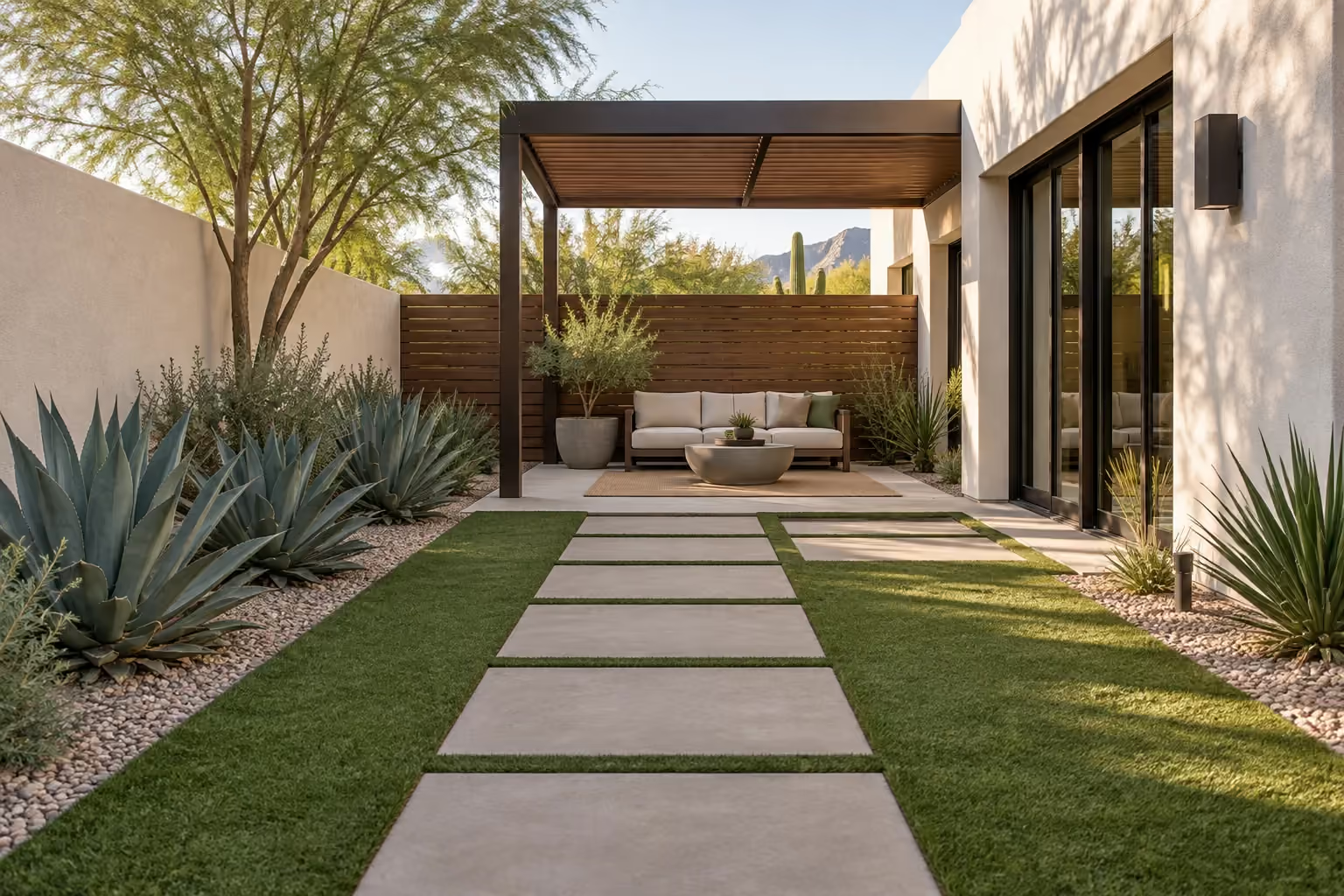
Bring the space together
Look at the whole composition: surface, architecture, planting and the places you want to spend time.
Illustrated design inspiration, not completed-project photography.Questions worth asking
Before the project begins.
Is paver restoration the same as pressure washing?
No. Restoration may involve cleaning, stain assessment, joint renewal, coating treatment or repairs. Pressure washing is only a possible cleaning method and must suit the material and joint system.
Can paver cleaning remove every stain?
No universal result can be promised. The material, contaminant, age, prior treatment and any etching determine what is achievable. A test area helps establish reasonable expectations.
Should joints be re-sanded after cleaning?
Assess the joint condition and selected system first. If material is missing, use a compatible product and follow its preparation and installation instructions. Re-sanding does not correct settlement.
Does cleaning need to include sealing?
Not automatically. Sealing depends on material, condition and finish objectives. Some surfaces do not need a sealer; incompatible or premature treatment can create problems.
Keep exploring
Connected decisions.
A good place to begin
Make room for
something beautiful.
Share your space, your ideas and the work you have in mind. Start with a project-specific conversation.
Request a free quote